Artificial Intelligence for Transforming Customer Experience
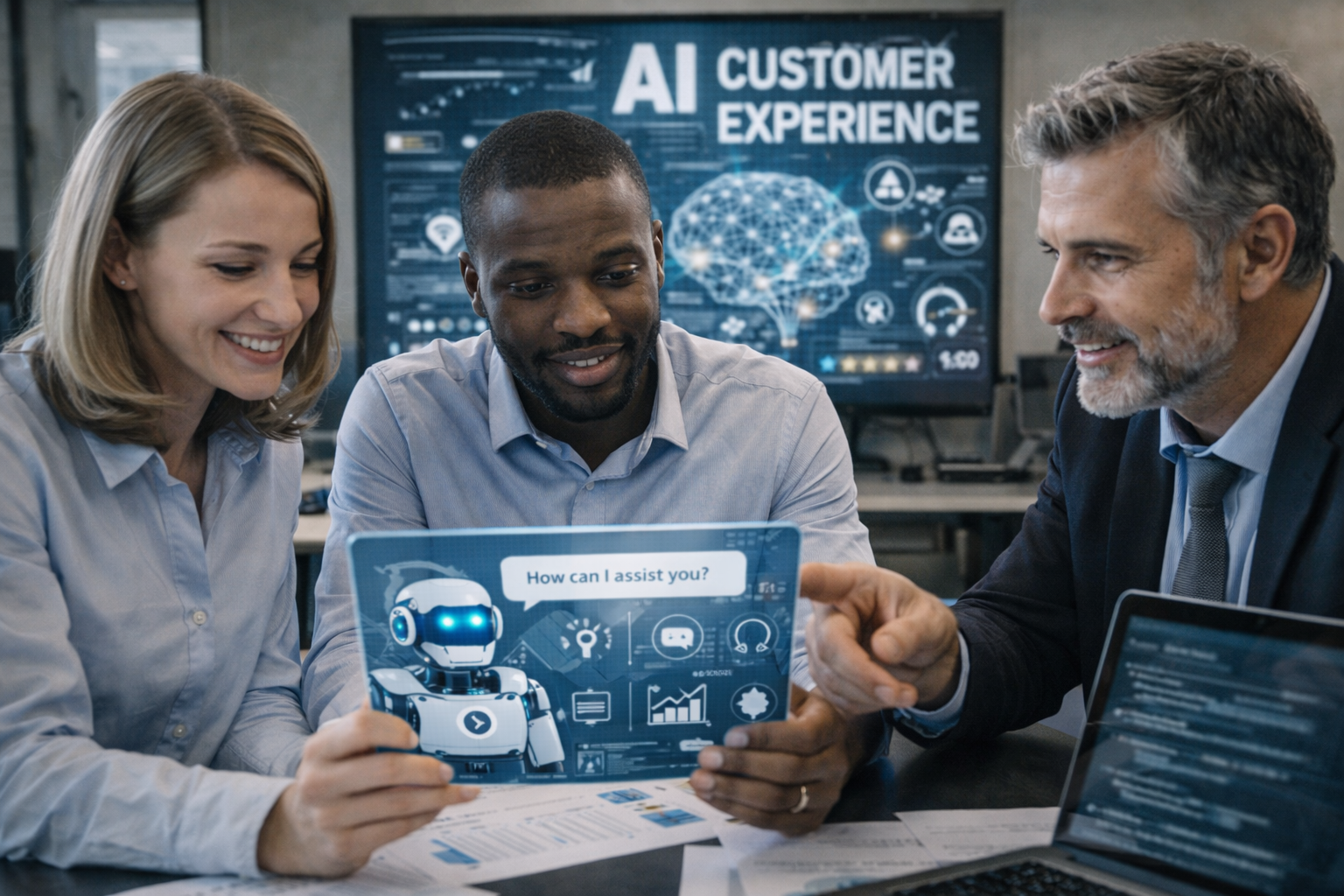
From Efficient Interactions to Differentiated Relationships
Most organizations describe customer experience as a strategic differentiator, but they do not always manage it accordingly. Despite significant investments in digital channels, CRM platforms, and automation, customers continue to encounter friction, inconsistent responses, and services that lack personalization.
Artificial intelligence offers a concrete opportunity to close this gap—not by replacing human contact, but by enabling experiences that are more relevant, consistent, and scalable.
Why Customer Experience Is Fertile Ground for AI
Customer experience combines four elements that make AI particularly valuable:
- High volumes of interactions across multiple channels
- Fragmented data across sales, service, and operations
- Rising expectations for speed and personalization
- Direct effects on revenue and costs through retention, cross-selling, and operational efficiency
When designed correctly, AI can orchestrate these elements into a coherent experience from the customer’s perspective.
Use Cases with a Tangible Customer and Business Impact
Intelligent Customer-Journey Orchestration
AI models can anticipate customer needs and recommend the next best action based on behavior, context, and history. This moves the experience from a reactive model to a proactive one.
Typical impact:
- Higher retention rates
- Fewer repeated contacts for the same issue
AI-Augmented Customer Service, Not Customer-Service Replacement
Intelligent assistants and agent-support systems enable employees to resolve inquiries more quickly and consistently, even in complex situations. The value lies not only in automation, but in improving the quality of every interaction.
Typical impact:
- Lower average resolution time
- Greater customer and employee satisfaction
Personalization at Scale
AI can adapt content, offers, and communications in real time according to each customer’s profile and current context. This goes beyond traditional segmentation and enables genuinely individualized experiences.
Typical impact:
- Greater engagement
- Higher conversion across campaigns and self-service channels
Early Detection of Friction and Churn Risk
Natural-language analysis and behavioral patterns can identify early signs of dissatisfaction before a customer decides to leave. This enables timely and focused interventions.
Typical impact:
- Reduced churn
- Improved customer-loyalty metrics
The Common Risk: Optimizing Channels Without Designing Experiences
A frequent mistake is applying AI in isolation at specific points in the customer journey—such as chatbots, surveys, or automated responses—without an integrated perspective. The result is often a fragmented experience, even when the underlying technology is advanced.
Leading organizations begin with a different question:
How should customers feel at every critical moment in their relationship with us?
AI is then designed to enable that intended experience.
How to Structure an AI Strategy for Customer Experience
Companies that achieve sustained improvements in customer experience generally follow four steps:
- Map critical journeys and prioritize moments of truth with a significant emotional and financial impact
- Define clear metrics beyond NPS, including customer effort, first-contact resolution, and consistency
- Integrate data and decisions to eliminate silos between channels and departments
- Align people, processes, and technology to ensure genuine adoption in daily operations
The Role of Leadership in Customer-Experience Transformation
Customer experience does not improve solely through more sophisticated models. It requires organizational decisions such as:
- Empowering frontline teams with better tools and greater autonomy
- Redefining incentives to prioritize quality over volume
- Recognizing that personalization requires controlled variability rather than rigid processes
Without this leadership, AI merely accelerates an experience that was already deficient.
Conclusion
Artificial intelligence can transform customer experience, but only when it is used to redesign the customer relationship rather than optimize isolated interactions. Organizations that embrace this perspective are creating differentiated experiences that are difficult to replicate. Others risk providing service that is efficient but indistinguishable from their competitors.
Competitive advantage no longer lies in responding faster, but in understanding customers better and acting sooner.