Artificial Intelligence for Decision-Making
How to Move from Assisted Intuition to Consistently Better Decisions
In most organizations, critical decisions are made under pressure, with incomplete information and within increasingly short timeframes. Nevertheless, many companies continue to rely primarily on individual experience, historical judgment, and descriptive reports explaining what has already happened.
Artificial intelligence offers a clear opportunity to improve decision quality—not by replacing leaders, but by expanding their ability to evaluate options, anticipate consequences, and act with greater precision.
Why Decision-Making Is the Greatest Value Multiplier
Strategic and operational decisions share three essential characteristics:
- They recur with variations, even when perceived as unique
- They have cumulative positive or negative effects on business performance
- They are exposed to human biases such as overconfidence and resistance to change
AI can capture historical learning and transform it into consistent, scalable recommendations.
How AI Improves Decision-Making
From Descriptive to Prescriptive Analysis
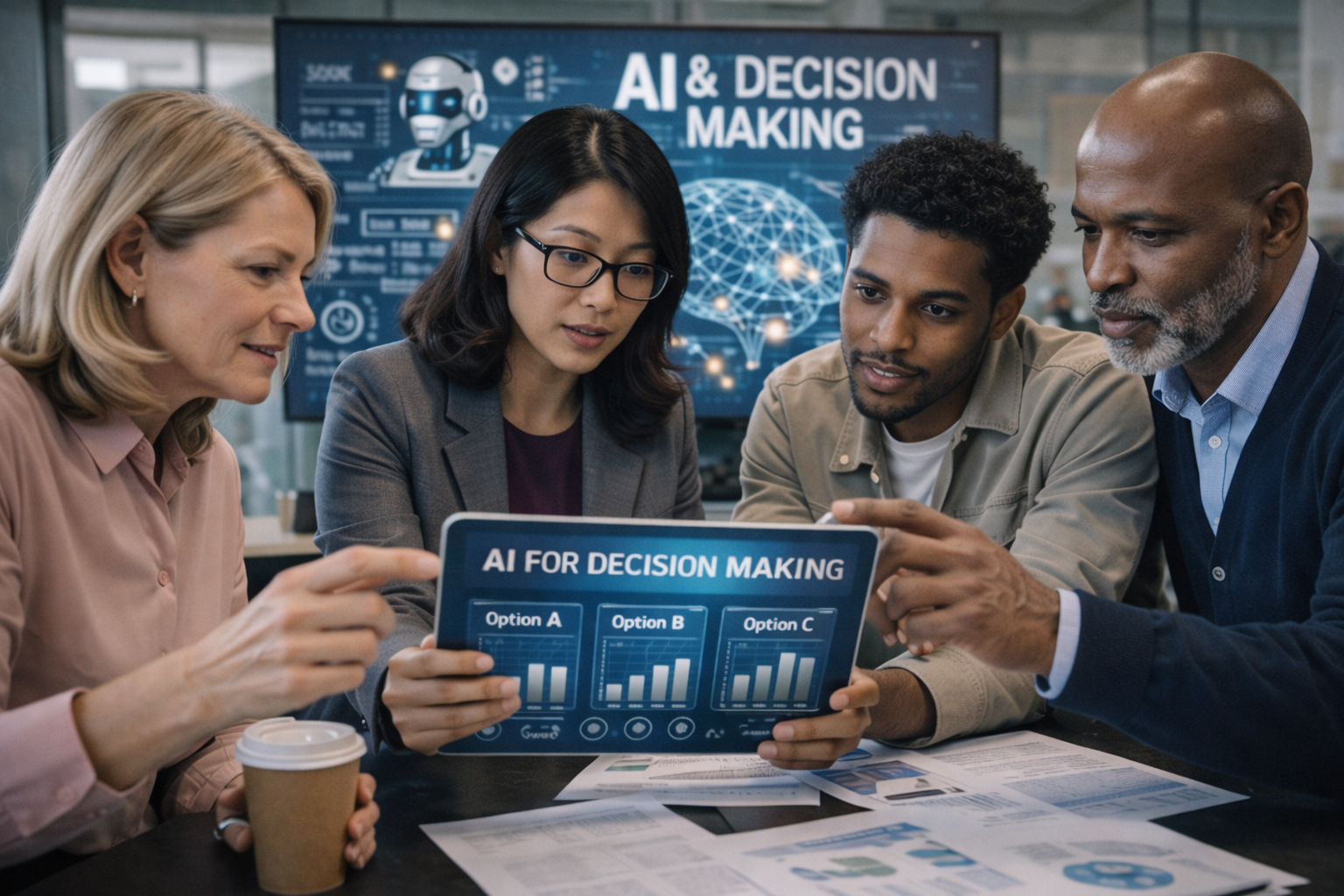
While traditional dashboards show what happened, AI can recommend what to do next by evaluating multiple scenarios and their expected outcomes.
Typical impact:
- Faster, better-supported decisions
- Less dependence on ad hoc analysis
Systematic Scenario Assessment
Predictive models can simulate alternative scenarios, quantifying risks, probabilities, and trade-offs before action is taken.
Typical impact:
- Fewer reactive decisions
- Greater clarity under uncertainty
Consistency in Operational Decisions
When different teams make similar decisions, AI can reduce variability and dependence on undocumented knowledge.
Typical impact:
- More consistent execution
- Lower operational risk
Early Identification of Weak Signals
AI can detect emerging patterns that indicate problems or opportunities before they become apparent through human analysis.
Typical impact:
- Earlier action
- Fewer strategic surprises
The Key Risk: Delegating Without Governing
A common mistake is assuming that an AI-recommended decision is correct by definition. Organizations that create real value clearly establish:
- Which decisions are automated, which are supported by recommendations, and which remain entirely human
- Which criteria the model uses and where its limits lie
- How decision performance—not merely model performance—is measured
AI should augment judgment, not replace it.
How to Structure an AI-Augmented Decision Strategy
More mature companies follow four principles:
- Classify decisions according to impact and frequency, prioritizing those with the highest potential return
- Integrate AI at the moment the decision is made rather than using it only for retrospective analysis
- Design explainable models that leaders can understand and challenge
- Close the learning loop by incorporating actual outcomes into the model
The Role of Leadership in AI-Supported Decisions
For AI to genuinely improve decision quality, leaders must:
- Establish clear standards governing when and how AI recommendations should be used
- Address cultural resistance to decisions that may appear counterintuitive
- Accept that some decisions will improve gradually rather than becoming perfect immediately
Without this leadership, AI becomes another analytical tool instead of a competitive advantage.
Conclusion
Artificial intelligence does not eliminate uncertainty, but it enables organizations to manage it more effectively. By transforming data into actionable recommendations, AI supports decisions that are more consistent, timely, and aligned with business objectives.
The true advantage does not lie in having more information, but in making consistently better decisions.